The Church
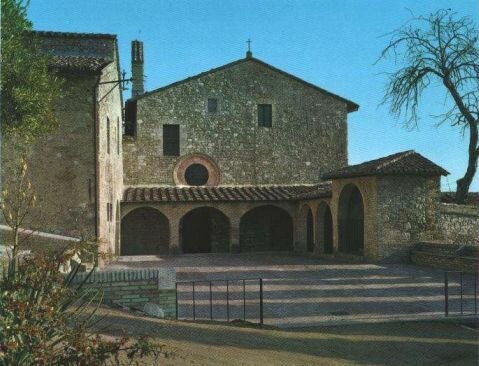
When we reach the small square before the church of St. Damian, we find a set of asymmetrical buildings that are joined together by a simple arcade.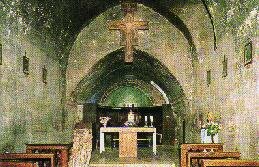
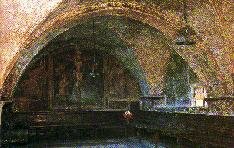
The little church is rather dark inside and the walls have been blackened by the smoke of the oil lamps. On the arch in front of the altar is a copy of the crucifix that
spoke to St. Francis to tell him to repair God’s house. The original crucifix is preserved in the Basilica of St. Clare.
- History of St. Damian’s
-
The church was in ruins when St. Francis first went there at the beginning of his spiritual transformation.
When the saint saw this church, set back on the gently sloping hills of Assisi, he wanted to go in there to meditate. Standing before the crucifix, he began to pray to the
Lord.
The image of Christ on the cross spoke to him, saying, "Francis, go and repair my church, which is in ruins."
The young man returned home, took as much fabric as he could carry from Peter Bernardone’s shop and went to Foligno.
With the money he earned selling the cloth, he returned to St. Damian’s, but the priest who took care of the little church recognized him and, fearing the rage of Francis’
father, refused to accept the money. It was for this reason that Francis threw the coins from the little window that can still be seen just at the entrance to the church.
This was the episode that represents St. Damian’s main tie to Franciscanism and St. Francis went back to the little church many times. However, he returned mainly to
visit Clare of Assisi and indeed, St. Damian’s is connected mainly with the figure of St. Clare, who lived there from 1211 until 1253.
St. Francis stayed there for an extended period of time in 1225 when, ill and weak, he composed the Canticle of Brother Sun.
The body of the Poor One was brought there on October 4, 1226, on the morning after he died at the Porziuncola, during the procession to bring his remains to the
church of St. George, and Clare and her Sisters bid him their final farewell at that time.
The life led by St. Clare at the church of St. Damian was marked by prayer and contemplation, as well as several miracles she performed, such as the multiplication of
bread and oil, miraculous cures and the sign of the cross that appeared on the loaf of bread given to the Pope.
Even more substantial were the works done by St. Clare in 1240 and 1241, when she miraculously drove away the Saracen and Tartar troops, mercenaries soldiers who,
at the service of Frederick II, got as far as the monastery with the intention of laying waste to the city of Assisi.
The second miracle took place during the last days of her life when, due to illness, she was unable to attend an important ceremony held at the Basilica of St. Francis.
Nevertheless she was able to observe all the religious sequences from her sickbed. It is because of this miracle that she has recently been named the Patron Saint of
Television.